Portugal vs. Spain: Where Should You Move in 2026?
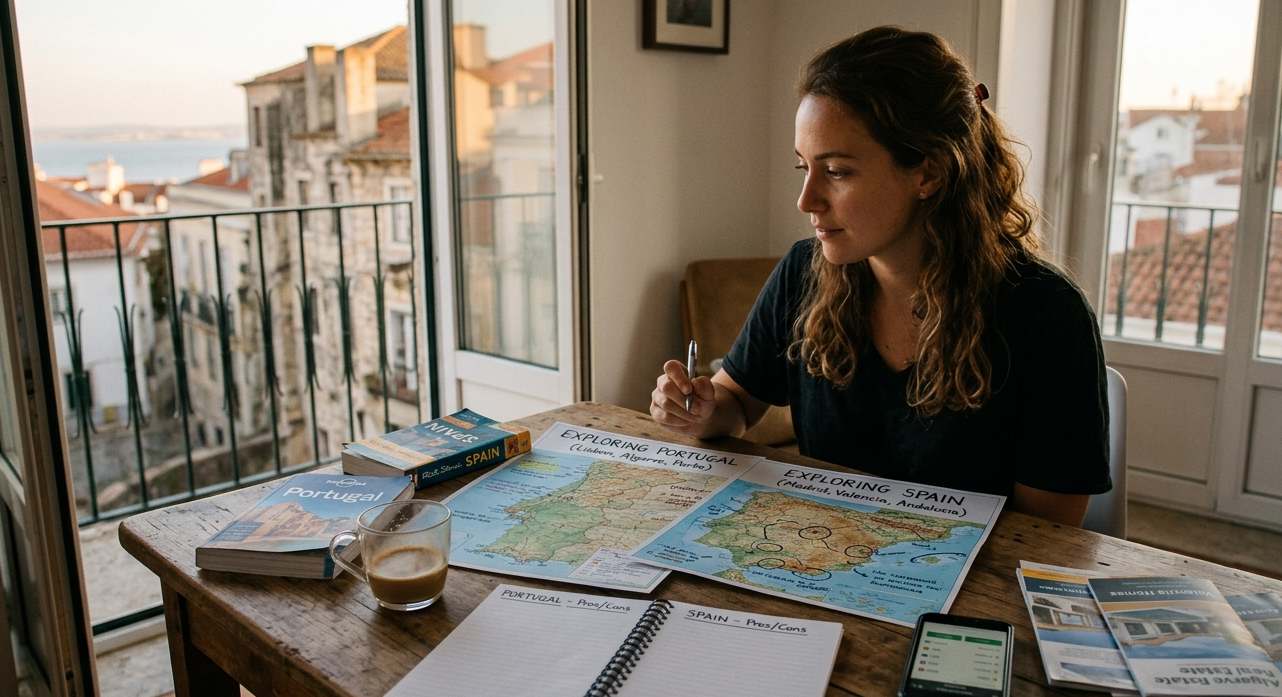
Portugal vs. Spain? This question comes up constantly among people planning a move to Southern Europe. And honestly, it’s not an easy one. Both countries are at the top of every expat list. Warm climate, affordable compared to the US or Northern Europe, decent healthcare, and real visa options for non-EU citizens. On paper, they look similar.
In practice, they’re quite different. Once you dig into the taxes, the job market, the daily pace – the gap becomes clear. Whether you’re after a busy city or somewhere quiet by the coast, choosing to live in Portugal or Spain means looking closely at your finances and the kind of life you actually want.
Cost of Living: Portugal vs. Spain
The cost of living in Spain vs Portugal in 2026 – Portugal still wins on price. On average, about 15-25% cheaper, especially rent and food. A one-bedroom in central Lisbon runs around €1,300. Madrid or Barcelona? Usually above €1,600 for something comparable. Groceries and utilities lean slightly lower in Portugal, too.
A dinner for two in Porto averages around €35. Barcelona, you’re looking at €50 easily. Monthly transport passes are similar – €30-45 in both countries. That said, if you eat out a lot or rent in a central neighbourhood, the difference in your monthly total starts to feel real pretty quickly.
Spain does have more variety, though. Lisbon and Porto are Portugal’s main hubs. Spain has Valencia, Málaga, and Alicante – mid-sized cities where the cost of living in Spain vs Portugal gap almost disappears.
Is Portugal cheaper than Spain? Overall, yes. For retirees or remote workers on a fixed income, that difference adds up every month. But if you want a bigger city with more going on, Spain is worth the extra cost.
Visas and Residency Options
Both countries have built a real visa infrastructure for foreigners. Portugal has the D7 passive income visa popular with retirees, a Digital Nomad Visa for remote workers, and the Golden Visa – still available but now only through private equity funds, not real estate. Spain offers the Non-Lucrative Visa for people not working locally, as well as its own Digital Nomad Visa.
When comparing Spain vs. Portugal for expats, the citizenship timeline is often what tips the decision. Portugal lets you apply after 5 years of residency – one of the fastest EU passport routes. Spain requires 10 years for most people, though Latin American citizens qualify in 2. That gap matters a lot if getting an EU passport is part of the long-term plan, not just a nice-to-have.
Taxes, Healthcare, and Public Services
This is where Portugal vs. Spain living gets complicated. Portugal had the NHR tax regime, which was generous for foreign residents for years. The original program changed, but new incentives still offer a flat 20% rate on certain qualifying income for new arrivals. Spain taxes worldwide income at progressive rates up to 47%. The Beckham Law helps some qualifying workers, but for Americans especially, Spain’s tax burden can be a shock. Worth talking to a cross-border tax advisor before committing to either.
Healthcare: Spain’s public system consistently ranks higher – better hospital infrastructure, shorter waits. Portugal’s economy is working, but is strained in rural areas. Either way, most visa applicants start with mandatory private insurance, so the public system isn’t the first thing you’ll use.
A few other things worth knowing:
- English – Portugal ranks higher on the EF English Proficiency Index. Getting through daily life in English is realistic in Lisbon and the Algarve. In Spain, outside of international circles, Spanish is genuinely necessary.
- Rail – Spain’s AVE high-speed network is significantly better. Getting between cities is fast and cheap. Portugal’s is more limited.
- Bureaucracy – both countries are notoriously slow. Portugal’s digital services have been improving faster recently.
Lifestyle, Culture, and Day-to-Day Differences
Portugal vs. Spain: living day to day – this is where they really diverge.
Spain is loud in a good way. Dinner at 10 pm, bars until dawn, plazas full of people on a Tuesday. The culture is social, and it happens outside. It’s not something you ease into – you’re either into that energy, or you’re not.
Portugal is quieter, more understated. There’s a melancholy to it – saudade, Fado music, a slower pace. People don’t gather in public squares the same way. Evenings are calmer. It suits some people perfectly and drives others mad after six months.
Living in Portugal vs. Spain also means different weather than most people expect. Southern Spain – Andalusia, Seville – is seriously hot and dry in summer. 40°C days are normal. Portugal’s Atlantic coast is milder. July and August in Lisbon are warm, but there’s a breeze if you hate extreme heat. That gap is worth thinking about before you sign a lease in Málaga.
The expat community in Spain is larger and spread across more cities. Portugal’s main concentrations are in Lisbon, Porto, and the Algarve. Both are very safe countries by any global measure.
Spanish is more useful globally, no question. But Portuguese people speak much better English, which matters a lot in the first months when you’re still finding your feet.
Which Country Is Right for You?

Lower costs, faster EU passport, quieter life, easier English – Portugal. Bigger cities, more cultural energy, better infrastructure, vibrant social scene – Spain. Though it asks more of you on the language front, and that friction is daily, not occasional.
Both offer a quality of life that’s genuinely hard to find in North America or Northern Europe. The question is which version of it fits you. Most people who’ve lived in both say the decision comes down to personality more than practicalities.
One real piece of advice: spend a month in each country during the off-season before deciding. How a place feels in February is closer to daily reality than how it feels in July when everyone’s on holiday.
Not sure which visa fits your situation? Atlex Legal works with people moving to both Spain and Portugal. Book a consultation.
FAQ
Is Portugal or Spain cheaper for expats in 2026?
Portugal is still cheaper overall, especially housing and groceries. Mid-sized Spanish cities like Alicante and Valencia are closing the gap and offering more amenities.
Which country has a faster path to EU citizenship – Portugal vs. Spain?
Portugal – 5 years. Spain requires 10 for most nationalities, 2 for citizens of former Spanish colonies.
Do I need to speak the local language to live in Portugal or Spain?
In Portugal, you can get by in English in major cities and the Algarve. In Spain, speaking Spanish is close to essential.
Which country has better healthcare for expats?
Spain ranks higher for infrastructure and accessibility. Both have solid private options.
Can I get a digital nomad visa in both Portugal and Spain?
Yes, both have active Digital Nomad Visas in 2026 – each requires proof of remote income above a set monthly threshold.